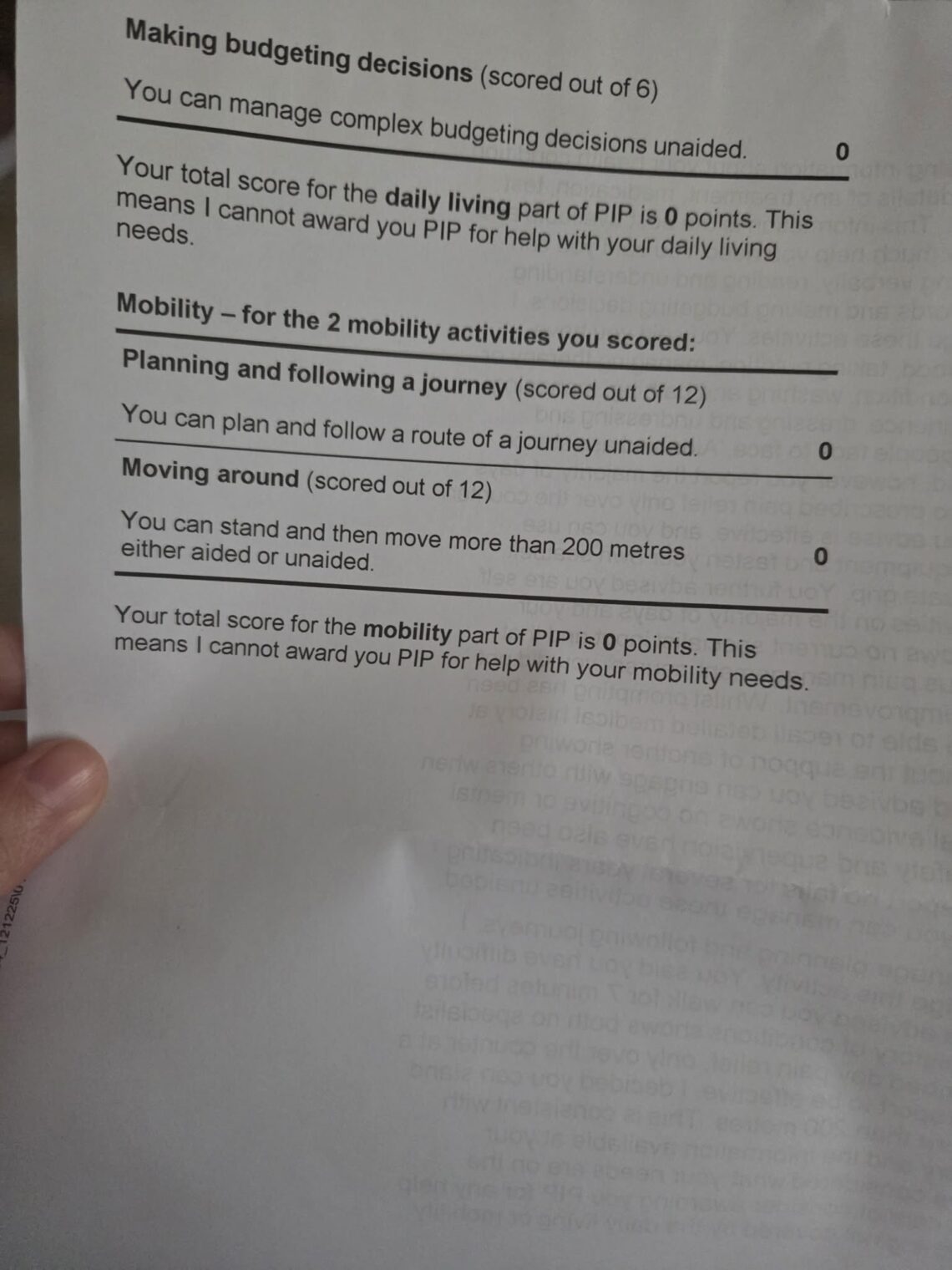
A “0 points” decision means the DWP assessor has said you don’t meet any of the descriptors for daily living or mobility. That does not automatically mean:
- your difficulties aren’t real
- you were “overreacting”
- you don’t have a case
Independent research and charities report that lots of people get 0 points at first, only to have the decision changed at mandatory reconsideration or appeal, sometimes all the way up to enhanced rate.
You have rights. You have options. And you are allowed to challenge this.
Kind Health Hub have put together these suggestions to help you through receiving a rejection letter from the DWP.
Pause, breathe, and protect your energy
Before you do anything practical:
- Give yourself permission to feel angry, upset, and drained. This is a normal reaction, not a failing.
- Don’t rush into phoning DWP while you’re in tears or panic. You’ll think more clearly once you’ve slept on it or talked to someone you trust.
- Set a small goal: “Today I will just read the letter and note the deadline.” That’s it.
This process is a marathon, not a sprint. You are allowed to pace yourself.
Check the decision letter and note your deadlines
Take your PIP decision letter and look for:
- The date on the letter
- The explanation of your points (usually a table or bullet list)
- Any generic phrases like “you can do this safely, reliably and repeatedly”
You normally have 1 month from the date on the decision letter to ask for a Mandatory Reconsideration (MR) – this is the first formal challenge step.
If you are outside that month, you might still be able to ask for MR late if you have a good reason (illness, hospital, mental health crisis, bereavement etc.), but it’s helpful to get advice first.
Tip: Write the MR deadline clearly on a piece of paper or your calendar. Everything else works backwards from that date.
Read why they gave you 0 – and compare it to your reality
This bit can be painful, but it’s important.
- Go descriptor by descriptor (washing, dressing, preparing food, communicating, moving around, etc.).
- Read what they wrote for each activity.
- Underline or highlight anything that is:
- factually wrong (“you walk your dog daily” when you don’t)
- incomplete (“can cook” with no mention of risk, fatigue or help)
- over‑optimistic (they saw you walk 20m once and assumed you can always do it)
Advicenow and Citizens Advice both stress that you should check the decision against what actually happens on a typical bad day, not a one‑off better moment.
This is the raw material you’ll use to challenge the decision.
Decide if you want to challenge – and know that you can
You can challenge the decision if you think it’s wrong according to the PIP rules:
- you got no award (0 points)
- you think the assessor misunderstood your needs
- the decision ignores important evidence
Most unfair decisions are worth challenging, and there is often “nothing to lose and everything to gain” – especially if you currently have no award at all.
If you already get some PIP (maybe from a previous claim) and you’re worried about losing it by challenging, speak to an advice service (Citizens Advice, welfare rights, disability charities) before you push ahead, because there can sometimes be risks.
If you were not provided with one, Request Your Assessor’s Report (PA4)
This is a powerful step many people don’t know about.
You can call the DWP and ask for “a copy of the assessor’s report (PA4)”. This document shows:
- what the assessor observed
- what they wrote
- how they justified your points
- where they misunderstood your needs
It’s often the clearest way to spot errors and build your case.
Compare Their Version of Events With Your Reality
Go descriptor by descriptor and highlight anything that is:
- incorrect
- exaggerated
- missing context
- based on assumptions
PIP is about what you can do safely, reliably, repeatedly, and to an acceptable standard — not what you can do once on a good day.
Remember — PIP Is About Function, Not Diagnosis
You don’t need a dramatic diagnosis. You need to show how your condition affects daily living and mobility.
This is where many people accidentally undersell themselves.
Ask for a Mandatory Reconsideration (MR)
You can request MR by phone or in writing, but writing is best.
Include:
- your name and NI number
- the date of the decision
- a clear statement that you’re requesting MR
- a note that more evidence may follow
This protects your deadline while giving you time to gather information.
📬 Where to send it
You should send your letter to the address on your decision letter — this is important because:
- Different PIP processing centres handle different regions.
- Sending it to the address on your decision letter ensures it goes straight to the team that made the original decision.
- It also ensures your request is logged correctly and on time.
For the guidelines of submitting a request for a Mandatory Reconsideration, go to:
Build Your Case With Clear, Real Examples
For each activity (e.g., preparing food, washing, engaging with people), explain:
- what happens on a bad day
- how often bad days occur
- what happens if you try without help
- any risks, pain, fatigue, or mental health impact
You can also use:
- a symptom diary
- letters from professionals
- statements from people who support you
You don’t need a mountain of evidence — just relevant, real examples.
📞 Call the DWP to Extend Your MR Deadline If Needed
If someone is unwell, overwhelmed, or dealing with a crisis, they can ask for extra time. The DWP often accepts late MRs when there’s a good reason.
Ask for a Mandatory Reconsideration (MR)
You must go through MR before you can appeal to a tribunal.
How to request MR:
- Best practice: Put it in writing (letter or form) so you have a record.
- You can also phone to register that you want MR, but follow up in writing if you can.
- Clearly state:
- Your name, NI number, date of decision
- That you are challenging the decision and requesting a Mandatory Reconsideration
- A short note that you’ll send more detail/evidence if you need a little more time
Citizens Advice and Turn2us both recommend keeping copies of everything you send and a note of dates and phone calls.
Even if your MR request is short at first, getting it in within the deadline protects your right to continue.
Read the PIP Assessment Guidelines published by DWP.
You can find the Pip Assessment Guide by clicking this link: This helps build a clear idea of what grounds you could challenge on.
Build your case – describe your real day, not your “coping mode”
Now you strengthen your MR with clear, detailed explanations.
When you write your MR reasons (or talk to an adviser):
- Base it around the PIP activities and descriptors, not your diagnosis alone. PIP is about how your condition affects you day to day.
- For each activity (e.g. dressing, preparing food, engaging with people):
- Explain what a bad day looks like
- How often that bad day happens (e.g. “4 days out of 7”)
- What would happen if you tried to do it without help (pain, exhaustion, panic, risk, accidents)
- Use the PIP law language where it fits:
- can you do it safely?
- reliably?
- to an acceptable standard?
- repeatedly (more than once in a day) without worsening your condition?
Advicenow has step‑by‑step PIP challenge guides with examples of how to write this up effectively.
Gather extra evidence (but don’t panic if you don’t have loads)
Evidence can help, but it doesn’t have to be a perfect stack of reports.
Useful evidence might include:
- Letters from your GP, consultant, therapist or support worker describing how your condition affects daily living or mobility
- Care plans, OT reports, social services assessments
- Medication lists (showing ongoing, serious conditions)
- Statements from people who support you (family, friends, carers) describing what they actually do to help you day to day
Turn2us and CPAG both emphasise that you should link evidence directly to PIP activities, not just the diagnosis name.
If you can’t get everything before the MR deadline, send what you have and explain that more is on the way if possible.
Send your MR – and prepare for a wait
Once your MR request and supporting reasons/evidence are ready:
- Send it recorded delivery if you can, or ask the Post Office for proof of posting.
- Keep a copy of everything.
- Make a note of the date you sent it.
DWP will look at your claim again. Sometimes they’ll call you for more information. It can take several weeks or even months to get a new decision.
This part is hard because it’s all waiting. You haven’t done anything wrong – the system is just slow and under‑resourced.
If MR fails, consider appealing to a tribunal
If the MR decision comes back and:
- they keep you at 0 points, or
- they give you less than you should be entitled to
…you can appeal to an independent tribunal.
Key points about appeals:
- You usually have 1 month from the MR notice to lodge an appeal.
- The tribunal is independent of the DWP – they look at the evidence afresh.
- Success rates at tribunal are much higher than at MR, especially for people who submit detailed evidence and attend the hearing (in person, phone or video) – many people win here even after getting 0 points twice.
Before you lodge an appeal, it’s very helpful to get advice from Citizens Advice, local welfare rights, Law Centre, or a disability charity if you can.
Look after yourself while all this is happening
This process can seriously grind people down. While you’re challenging the decision:
- Stay connected. Tell at least one trusted person what’s going on.
- Break tasks into tiny steps. “Today I will write about cooking.” “Tomorrow I will look at washing and dressing.”
- Use templates and guides. Advicenow, Citizens Advice and Turn2us all have practical PIP challenge tools, examples and checklists.
- Allow rest days. You are not lazy; you’re dealing with a system that demands a lot of emotional labour.
You deserve support, dignity, and a fair assessment of your needs. Getting 0 points doesn’t erase your reality.
Gentle reminder: You are allowed to try again
Many people only get the award they should have had after challenging:
- Some win at Mandatory Reconsideration
- Others win at appeal
- Some reapply later with better support and evidence
Advice now is blunt about it: the DWP often doesn’t apply the criteria correctly, and unfair decisions should be challenged.
You are not being “difficult” by standing up for yourself. You are using a right the system gives you – even if it doesn’t like to advertise it.
TOP TIP: Check out WWW.GOV.UK for help
If you want to understand exactly how the PIP scoring works, you can check the full list of descriptors and points on the official GOV.UK website.
🤝 You Don’t Have to Do This Alone
Challenging a PIP decision can feel overwhelming, especially when you’re already dealing with health issues, stress, or exhaustion. If you need help, please ask for it. You are not being a burden — this system is complicated, and nobody is expected to navigate it alone.
Support can come from many places:
- a family member who can help you read the letter or write your MR
- a friend who can sit with you while you go through the descriptors
- a support worker or carer who knows your day‑to‑day needs
- Citizens Advice, or a welfare rights adviser
- a solicitor or legal advocate, if your case is complex
- a charity linked to your condition (many offer PIP support)
Even having someone beside you while you make a phone call or draft a paragraph can make the process feel less heavy. You deserve support, and you’re allowed to ask for it.
🌟 A Final Word: Stay Steady, Stay Hopeful
If you’ve received 0 points, it’s completely understandable to feel defeated. But this is not the end. Many people go on to win their award at Mandatory Reconsideration or tribunal, even after being told they scored nothing.
So here’s what I want you to hold onto:
- You are not alone.
- You are not imagining your difficulties.
- You are not a fraud.
- You still have options.
Take it step by step. Rest when you need to. Reach out for support. And try — as best you can — to stay hopeful. We’re wishing you strength, clarity, and the best possible outcome as you move forward.
Visit WWW.GOV.UK to find out more about PIP, and check who’s eligible:
Last note: If your claim is rejected, remember that you have the right to reapply.
⚠️ Disclaimer
This blog is for general information only and isn’t a substitute for personalised legal or welfare‑rights advice. PIP rules can be complex, and everyone’s situation is different. If you’re unsure about your next steps, consider speaking with a qualified adviser or support organisation. It does not guarantee a successful application or outcome.