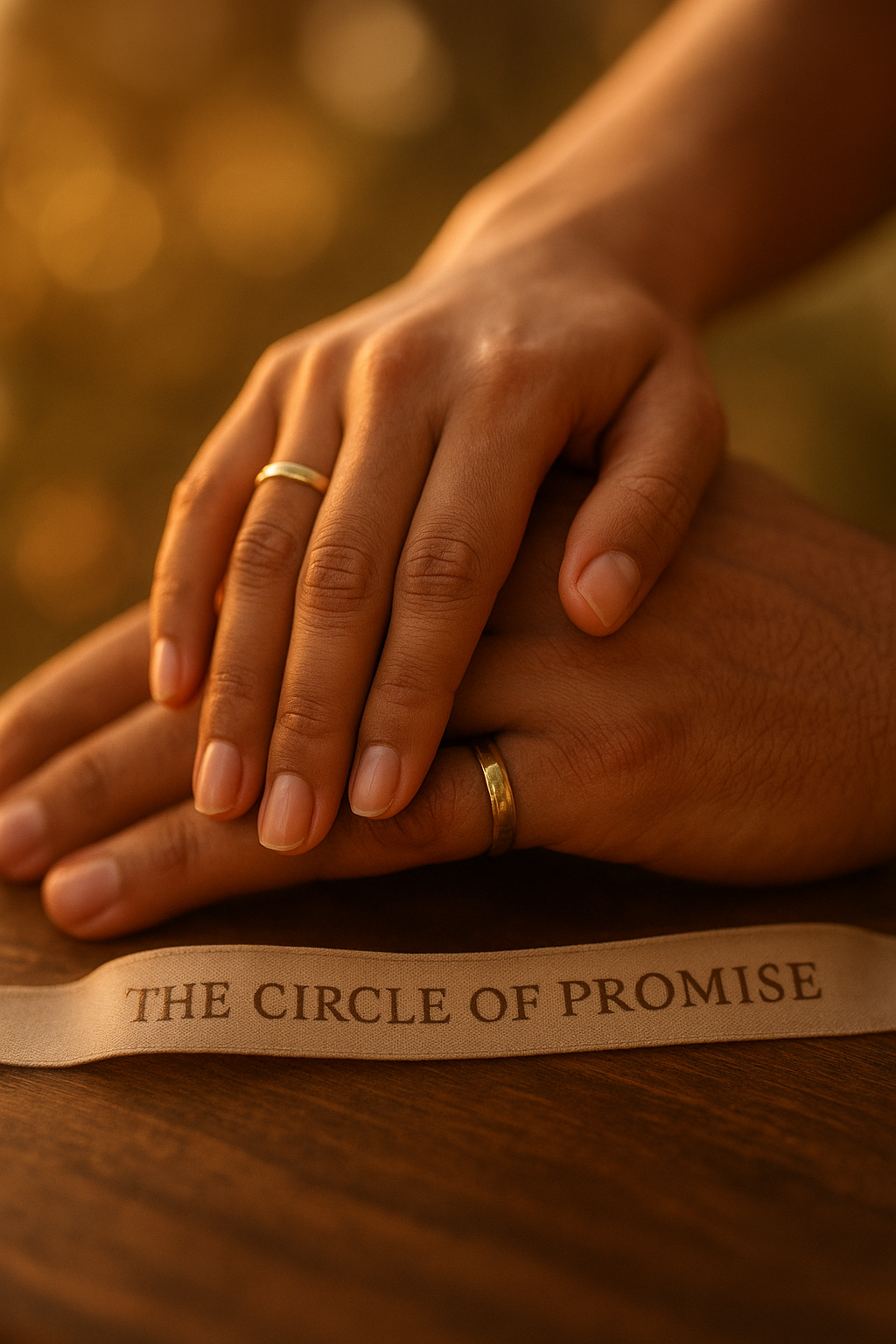
Chapter: The Circle of Promise
It begins with a circle. A shape without beginning or end, a line that returns to itself, eternal. For thousands of years, human beings have chosen this form to embody the most intimate of vows: the wedding ring.
The Left Hand and the Vein of Love
In the temples of ancient Egypt, reeds were braided into rings and slipped onto fingers as tokens of eternity. The Egyptians believed that the fourth finger of the left hand carried a secret vein — the vena amoris, the vein of love — flowing directly to the heart. Though anatomy would later prove this vein a myth, the poetry of the idea endured. When the Romans inherited Egyptian customs, they too placed rings upon the left hand, binding law, property, and affection in a single gesture.
Across centuries, the symbolism spread. In England, France, and America, the left hand became the chosen bearer of the ring. Yet in Russia, Greece, and Spain, the right hand was preferred, echoing biblical references to the “right hand of God.” Thus, even in the simple act of wearing a ring, cultures diverged, each weaving their own meanings into the circle.
The Third Finger
Why the third finger? Counting once began not with the thumb but with the index finger, making the fourth finger the “third.” This finger, delicate and less used than others, seemed destined for ornament. The Romans believed it carried the vein of love, and so it became the finger of vows. Even today, when science has stripped away the myth, the tradition remains — a testament to the endurance of symbolism over fact.
The Word “Ring” and the Sound of Bells
Language, too, tells its story. The word ring comes from the Old English hring, meaning a circular band. Yet it shares its root with the verb “to ring,” the sound of a bell. Both words are born of resonance and repetition: the circle of metal, the circle of sound. When church bells ring at a wedding, their echo joins the circle on the finger, binding sound and symbol into one ritual.
Why We Wear Them
A ring is more than an ornament. It is a public declaration, a visible bond. In Christian Europe, rings were blessed by priests, sanctified as tokens of divine union. In secular societies, they became emblems of fidelity, worn not for God but for community, for the world to see. To wear a ring is to say: I am bound, I am chosen, I am committed.
Origins in Religion and Beyond
The wedding ring did not begin with Christianity. Its roots lie in Egypt, in Rome, in pagan rites of eternity. Christianity absorbed the custom, weaving it into liturgy by the ninth century. Judaism, Hinduism, and Islam each developed their own traditions, sometimes with rings, sometimes with other tokens. The ring is not universal, but where it appears, it carries the same weight: permanence, devotion, covenant.
A History in Metal and Stone
- Egypt (3000 BCE): rings of reeds, ivory, and leather, fragile yet symbolic.
- Rome: iron rings for contracts, later gold for permanence.
- Medieval Europe: engraved rings, inscribed with prayers or names, blessed in church.
- Renaissance: gem-set rings, artistry, and wealth displayed on the hand.
- Victorian era: ornate designs, sentimental motifs, lockets and hidden inscriptions.
- Modern age: plain gold bands, platinum circles, diamond-studded rings — equality and endurance made visible.
The Circle Endures
Through empires and religions, through myth and science, the ring has remained. It is the circle of promise, the echo of bells, the vein of love imagined beneath the skin. To slip a ring upon a finger is to join a story older than writing, older than nations — a story of eternity, of devotion, of the human need to make love visible.
Celebrate your love story: “A wedding ring is more than jewellery — it’s a symbol of your journey together,
Disclosure: As an Amazon Associate I earn from qualifying purchases. This helps support my blog at no extra cost to you.
Image for illustration purposes only.
Disclaimer: Kind Health Hub provides content for general informational and educational purposes only. While every effort is made to ensure accuracy, details about products, services, policies, and lifestyle guidance may change over time. Readers should always verify information directly with manufacturers, healthcare providers, or official sources before making decisions. The content does not constitute medical, nutritional, financial, or legal advice, and any recommendations are shared for general guidance only.
Click to find a simply stunning ring that we are sure you will love – It’s classy and affordable.