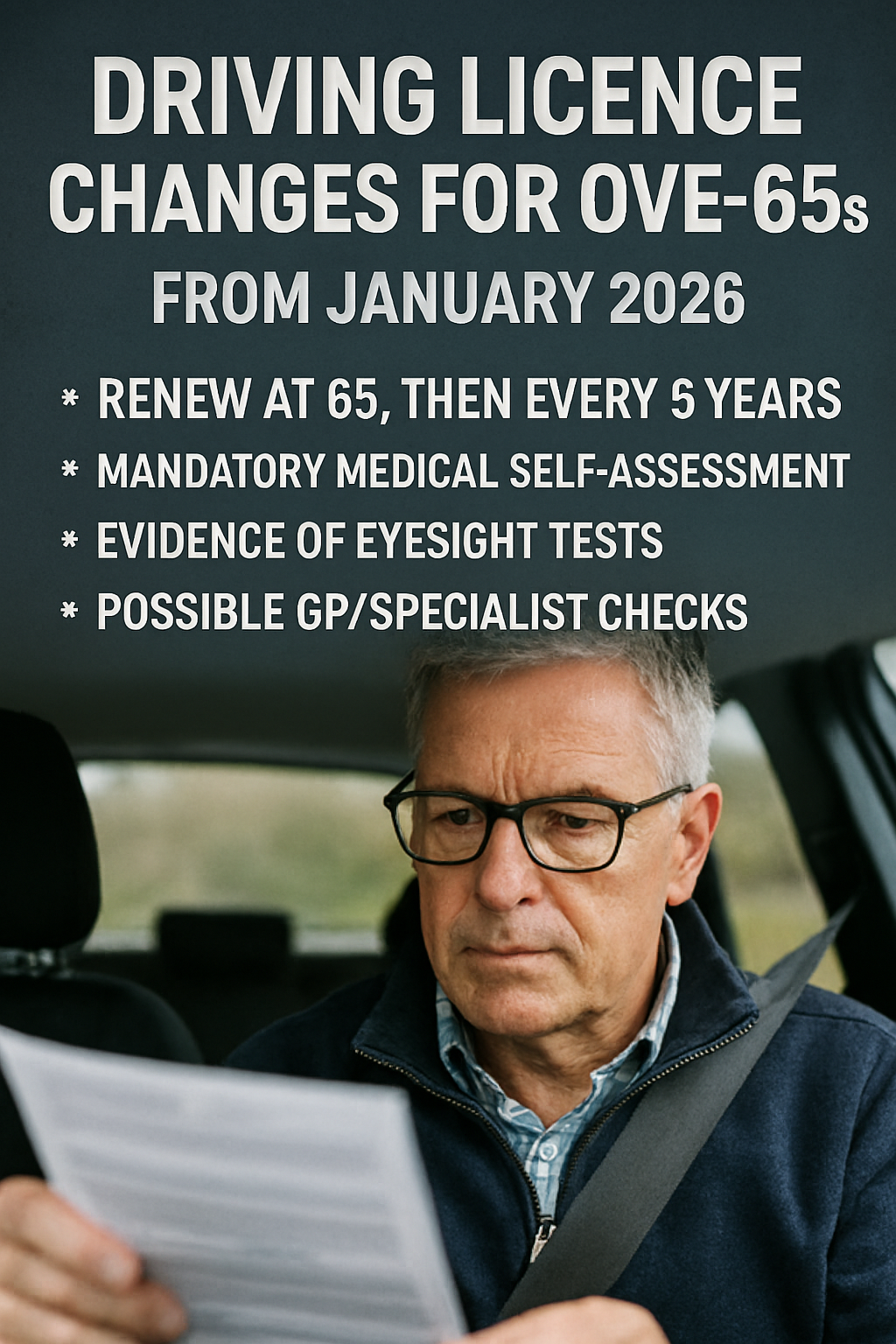
From January 2026, the UK Government is introducing new driving‑licence rules for people aged 65 and over. These changes are intended to improve road safety, but many drivers argue that targeting people purely by age is unfair and ineffective. Medical conditions, eyesight issues, and medication‑related impairments affect drivers of all ages, not just older adults.
According to early guidance, the new rules aim to ensure licences “accurately reflect medical fitness to drive”. But if the Government expects only an “extreme minority” of older drivers to lose their licence, then these new checks may not remove many unsafe drivers from the road at all.
What Over‑65s Must Now Do to Stay on the Road
Here is a clear breakdown of what is actually changing — compared to what drivers already must do today.
Comparison Table: Current Rules vs 2026 Over‑65 Requirements
| Requirement | Current Rules | 2026 Rules for Over‑65s |
|---|---|---|
| Licence renewal age | Renew at 70, then every 3 years | Renew starting at 65, then every 3 years |
| Medical declaration | Self‑declare conditions at renewal | Mandatory medical self‑assessment every 3 years |
| Eyesight testing | Must meet legal standard; self‑managed | Must submit professional eyesight test results every 3 years |
| GP or specialist involvement | Only if DVLA requests it | May require GP or specialist reports even without DVLA referral |
| Licence validity | 3‑year licence from age 70 | Shorter validity may apply from age 65 depending on health status |
Why This Matters
Drivers are already legally required to:
- Wear corrective lenses if needed
- Meet the eyesight standard (read a number plate at 20m)
- Notify the DVLA of medical conditions
- Declare medications that may impair driving
The 2026 rules don’t introduce new safety principles — they simply shift from self‑responsibility to mandatory proof, but only for one age group.
This raises important questions about fairness and effectiveness.
How These Changes Could Affect Insurance and Daily Life
Older drivers may face:
- Higher insurance premiums if flagged for medical review
- Delays in licence processing due to GP backlogs
- Stress and uncertainty during the renewal process
- Loss of mobility if paperwork delays leaves them temporarily unable to drive
And for those aged 65–67, who are still working until the state pension age of 67, delays could mean:
- Time off work
- Loss of income
- Job loss if driving is essential
This is a major concern for rural areas like East Sussex, where public transport is limited and driving is often essential for employment.
Why Age‑Based Testing Isn’t Enough
If the Government wants to improve road safety, then medical and eyesight checks should apply to all drivers, not just those over 65.
Here’s why:
- Younger drivers also develop medical conditions that affect driving
- Accident data shows risk factors across all ages
- Fairness matters — age alone is not a reliable predictor of unsafe driving
- Universal testing would catch more unsafe drivers, not just a tiny minority
Even the Government acknowledges that only a very small number of older drivers are expected to lose their licence under the new system — meaning the policy may not significantly improve road safety.
Conclusion: Safety Should Be Universal, Not Age‑Restricted
The new over‑65 driving rules may be well‑intentioned, but they risk creating more problems than they solve. If only a tiny minority of older drivers are unsafe, then the new system is not removing many dangerous drivers — it’s simply adding paperwork, cost, and stress for millions of people.
Medical fitness matters. Eyesight matters. But these issues affect everyone, not just those over 65.
A fairer, more effective approach would apply the same safety checks to all drivers, regardless of age.
Tailored Version: For Working Drivers Aged 65–67
Driving Licence Changes Could Hit Working Over‑65s Hardest
From January 2026, new driving‑licence rules will apply to anyone aged 65 and over. While the Government says the aim is to improve road safety, the changes may have the biggest impact on people aged 65–67 — a group who are still working and rely on their vehicles for employment.
With the state pension age now at 67, thousands of people in this age bracket still drive for work, commute to jobs, or care for family members. Any delay in licence renewal could have serious consequences.
What Working Drivers Must Now Do
Drivers aged 65+ will be required to:
- Renew their licence at 65 instead of 70
- Submit a medical self‑assessment every 3 years
- Provide professional eyesight test results
- Undergo GP or specialist checks if requested
- Wait for DVLA approval before continuing to drive
These steps may sound simple, but in reality they involve GP appointments, optician visits, paperwork, and DVLA processing times — all of which can take weeks or months.
How This Could Affect Employment
For working drivers aged 65–67, the risks include:
- Being unable to drive while waiting for renewal
- Loss of income for self‑employed or gig‑economy workers
- Job loss for those in driving‑dependent roles
- Increased insurance costs if flagged for medical review
- Stress and uncertainty during the process
This is especially concerning in rural areas where driving is essential and public transport is limited.
A Fairer Approach Is Needed
If the Government wants to improve road safety, then medical and eyesight checks should apply to all drivers, not just those over 65. Targeting one age group creates inequality and does little to remove unsafe drivers from the road.
A universal system would:
- Improve safety more effectively
- Reduce stigma
- Protect working older adults
- Ensure fairness across all age groups
Final Thought
Working drivers aged 65–67 are at real risk of being caught in administrative delays that could cost them their jobs. If only a tiny minority of older drivers are unsafe, then the new rules are not solving the problem — they’re simply shifting the burden onto people who still need to work.
A safer system is possible — but it must be fair, consistent, and based on medical need, not age.
Disclaimer: The information provided in this article is intended for informational purposes only. It does not constitute legal advice, medical advice, or professional guidance. While every effort has been made to ensure accuracy, regulations and DVLA requirements may change, and interpretations may vary. Readers are responsible for verifying current rules directly with official sources and seeking professional advice where appropriate. The author and website accept no liability for actions taken based on this content.