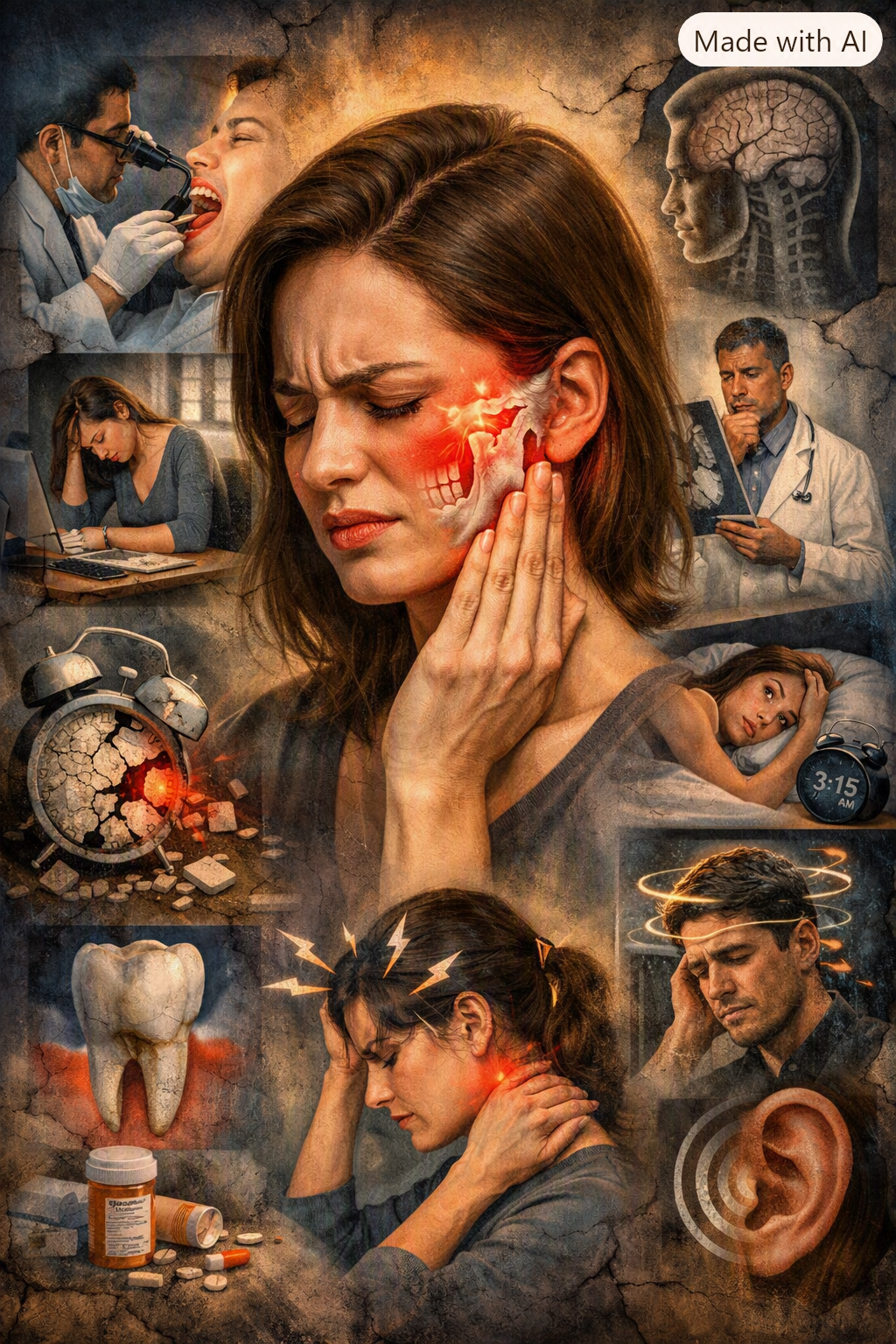
And Why Doctors Keep Missing It
Most people have never heard of TMJD. Yet it affects more people than asthma, diabetes, or depression. It is one of the most common chronic pain disorders in the UK — and one of the least understood.
TMJD (temporomandibular joint disorder) is often dismissed as “jaw pain,” but the reality is far more serious. It can cause migraines, ear pain, dizziness, facial numbness, neck stiffness, tooth damage, sleep disruption, and in severe cases, jaw locking that leaves people unable to eat or speak.
Despite this, TMJD remains under‑diagnosed, under‑treated, and dangerously underestimated.
This is the story of a condition affecting millions — and a healthcare system not trained to treat it.
The Silent Epidemic No One Talks About
TMJD affects an estimated 10–15% of adults, making it one of the most widespread musculoskeletal disorders in the world. Yet most people don’t know they have it.
Why?
Because TMJD hides behind symptoms that look like other conditions:
- migraines
- sinus pressure
- ear infections
- tinnitus
- neck pain
- facial pain
- tooth sensitivity
- dizziness
- clicking or popping in the jaw
Patients bounce between GPs, dentists, ENT specialists, neurologists, and physiotherapists — often for years — without receiving a diagnosis.
This is not rare. This is not niche. This is a public health blind spot.
The Condition Doctors Keep Missing
TMJD is notoriously misdiagnosed. Not because doctors don’t care — but because medical training barely covers the jaw joint at all.
Most GPs receive zero formal training in TMJD. Dentists receive minimal training, often focused on teeth rather than the joint. ENT doctors focus on ears and sinuses. Neurologists focus on nerves. Physiotherapists focus on muscles.
The jaw sits at the intersection of all these systems — yet belongs fully to none.
This creates a dangerous gap where patients fall through the cracks.
Why Women Suffer More — And Why They’re Dismissed
TMJD disproportionately affects women aged 20–40. Research suggests hormonal fluctuations, hypermobility, and connective‑tissue differences play a role.
But there’s another reason women suffer more:
medical bias.
Women reporting jaw pain are often told:
- “It’s stress.”
- “It’s anxiety.”
- “It’s tension headaches.”
- “It’s hormonal.”
- “It’s nothing serious.”
This dismissal delays diagnosis, worsens symptoms, and leaves women navigating chronic pain alone.
TMJD is not “just stress.” It is a complex neuromuscular disorder — and it deserves serious attention.
The Trauma Connection: When Jaw Pain Isn’t Just Physical
One of the most intriguing — and least discussed — aspects of TMJD is its link to trauma and chronic stress.
The jaw is part of the body’s fight‑or‑flight system. When the nervous system is activated, the jaw tightens as a protective reflex.
People with trauma histories often develop:
- chronic clenching
- bruxism (teeth grinding)
- jaw muscle hyperactivity
- facial tension
- neck stiffness
Over time, this can lead to:
- joint inflammation
- disc displacement
- muscle spasms
- nerve irritation
- chronic pain
TMJD is not “in your head.” But the nervous system plays a powerful role — and ignoring it leaves patients untreated.
The TMJD Treatment Gap: A System Not Built to Help
Here is the most shocking truth:
There is no TMJD specialty in the UK.
No dedicated TMJ doctors. No TMJ surgeons (except for extreme cases). No TMJ clinics on the NHS. No unified treatment pathway.
Patients are left to navigate:
- dentists
- ENT doctors
- physiotherapists
- chiropractors
- neurologists
- pain clinics
- private specialists
- Botox providers
Each offers a piece of the puzzle — but no one offers the whole picture.
This is why TMJD becomes chronic. Not because it is untreatable — but because the system is not designed to treat it.
The Human Cost: Locked Jaw, Locked Life
TMJD doesn’t just cause pain. It steals daily function.
People with TMJD often struggle to:
- eat solid food
- speak for long periods
- sleep through the night
- work without pain
- exercise
- socialise
- concentrate
- maintain relationships
Severe cases involve:
- jaw locking
- inability to open the mouth
- nerve pain radiating into the face
- chronic migraines
- tooth wear and fractures
- depression and anxiety
TMJD is not “just jaw pain.” It is a life‑altering condition.
Why This Matters Now
TMJD is rising — fast.
Why?
- increased stress
- more screen time
- poor posture
- grinding and clenching
- dental misalignment
- trauma
- hypermobility conditions
- lack of early intervention
Yet the healthcare system has not adapted.
Patients are suffering. Dentists are overwhelmed. GPs are untrained. NHS pathways are unclear. Private treatment is inconsistent.
This is a public health crisis hiding in plain sight.
The Question the Public Must Now Confront
If TMJD affects millions, why is the UK healthcare system not trained to diagnose or treat it?
Why are patients left to suffer for years without answers?
And how many people are living with TMJD right now — without knowing it?
AI-generated picture.