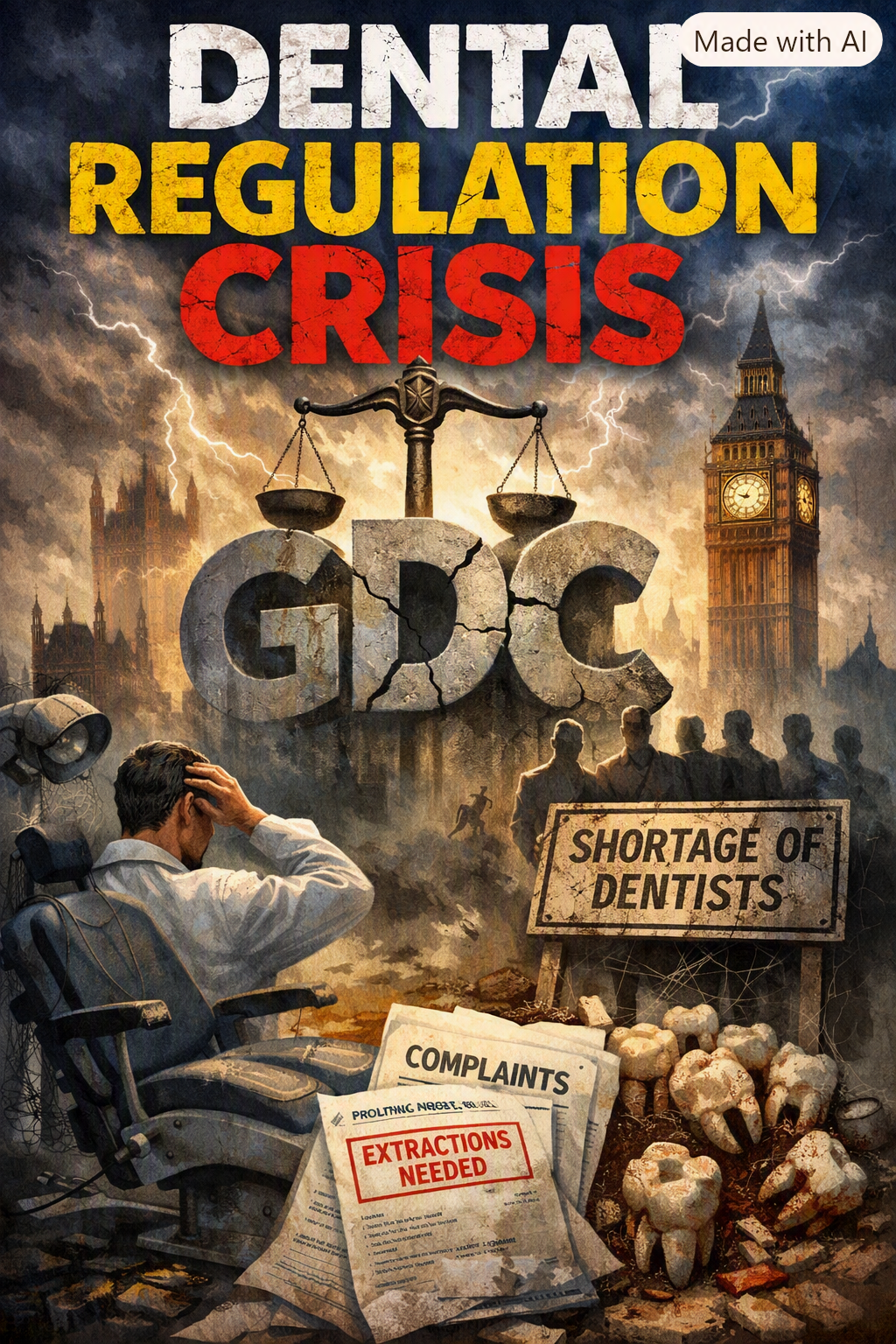
Is UK private dentistry safe in the hands of the GDC? Let’s explore a GDC outcome to find out.
Inside a Dental Complaint the Regulator Doesn’t Want You to See!
When most people think of dental regulation, they imagine a powerful watchdog guarding public safety. The General Dental Council (GDC) is supposed to be exactly that: the UK’s statutory regulator for dentistry, funded almost entirely by dentists themselves. Every year, thousands of practitioners pay their registration fees believing the GDC will uphold standards, protect patients, and ensure accountability when things go wrong.
But what happens when you actually submit a complaint? What happens when harm occurs? And what happens when you appeal a decision you believe is flawed?
Very few people ever see inside that process. I did. And what I found raises a disturbing question: Is the GDC quietly lowering standards because the UK is short of dentists?
Why I Made a Complaint
My story began with something simple: a routine dental examination. Two teeth showed signs of decay beneath existing restorations. The registrant photographed them, noted the decay, and discussed options. But no treatment plan was provided. No follow‑up was arranged. No response came to repeated requests for clarification. No treatment followed.
In my dental notes, the registrant wrote: “XR Plan: none for now.” Meaning — no treatment for now.
After raising many questions with the pratice over months and the registrant failier to respond, I was left deeply concerned and sought a prosthodontic specialist’s opinion, which confirmed the worst: both teeth were now unrestorable and required extraction. The specialist indicated the deterioration was likely preventable had treatment been provided when the decay was first identified.
That is why I made a complaint. Not for compensation. Not for conflict. But because preventable harm occurred — and the regulator should care. The public needs protection.
Who the GDC Really Are
The GDC presents itself as a guardian of standards. But buried inside its own Rule 9 appeal outcome is a very different message:
“The Registrar does not provide a dispute resolution service… the GDC does not resolve complaints for people.” This is a direct quote from my outcome.
In other words: The GDC does not resolve disputes. It does not assign blame. It does not act based on patient harm. It does not determine responsibility.
This is not the public perception of a regulator. And it is not what dentists believe they are paying for.
The Outcome: “Yes, He Did Things Wrong — but…”
After six months of waiting, wondering, and receiving no updates from the GDC, it pinged undexspectedly into my Gmail- the outcome arrived, but not as expected.
It acknowledged that the registrant’s care was below the expected level — yet concluded that the care was not unsatisfactory enough to take action.
Even though the dentist had failed to treat subgingival decay (decay below the gum line) that later resulted in two tooth extractions, because he had chosen to put the teeth “on watch” instead of providing treatment that I had requested.
Why?
“The care supplied… was below the expected level for some aspects of care, but the standard of practice was not unsatisfactory to the extent that the overall care was below a reasonable standard.”
In plain language: “Yes, the care was below standard — but not enough to act on.”
This is the definition of lowering standards.
The Prosthodontic Evidence: Serious Harm, Preventable — and Ignored
The GDC had clear evidence: a specialist report confirming that two teeth required extraction and that the deterioration was likely preventable.
Yet it concluded that the registrant’s failure to act did not amount to misconduct, even though the decay he identified and failed to treat later resulted in tooth loss.
This is not protecting patients. This is not protecting dentists. So what is it — a fear to reprimand?
Apparently so. The GDC also said:
“The Committee noted the wider context of workforce pressures within dentistry… We must consider the wider impact on the profession.”
That single sentence says it all. The dentists are not being reprimanded because of a shortage of dentists. Incredulous logic — but written in black and white.
Is Rule 9 Appeal: A System Designed to Say “No”?
When I appealed, the GDC “reviewed” my case.
They dismissed everything.
The Rule 9 reviewer wrote:
“The fact that the Applicant’s teeth subsequently deteriorated… does not establish that the Registrant’s earlier assessment was improper.”
Two teeth lost. Preventable harm. Specialist evidence. Ignored.
This is not a review. This is a rubber stamp.
And the GDC’s own website reveals why.
In July 2024, the GDC changed its publication policy and stated:
“This change in policy recognises that allegations are untested at an Interim Orders Committee hearing or review because its role is to assess risk and not to determine the facts of a case.”
Reflect on that for a moment.
Untested allegations. Not determining the facts of the case.
The GDC openly admits that at key stages of its process, it does not determine facts. It does not test allegations. It does not establish what happened.
Yet these are the same stages where decisions are made, cases are closed, and appeals are dismissed.
So when the GDC reviewed my Rule 9 appeal, they were applying a system that — by their own admission — does not determine the facts of the case.
If the regulator does not test allegations, does not determine facts, and does not investigate harm, then what exactly is being “reviewed”?
This raises the question of what the GDC interim orders committee actually does? What is the step in the process intended for? Is it even required?
In my case it acted as a barrior between the informant and the GDC pannel and served no other purpose.
Why This Matters for Dentists
Dentists fund the GDC. Dentists rely on it to regulate fairly. Dentists expect it to uphold standards.
Yet the GDC’s own documents emphasise what it cannot do:
- it cannot resolve complaints
- it cannot assign blame
- it cannot act based on patient harm
This is not a regulator designed to protect dentists.
And when standards are lowered to keep dentists in the system, everyone loses:
- patients lose trust
- dentists lose confidence
- the profession loses credibility
- the regulator loses legitimacy
This raises the question: Should dentists no longer be reprimanded because of a shortage of dentists? The GDC clearly believes so.
If that’s the case, what is the purpose of the GDC now? Why are dentists still paying for regulators if the regulators fail to regulate?
How can we, the patients, feel safe?
The Question the Profession Must Now Confront
Whilst there is a shortage of dentists, does it mean the GDC should reduce its standards to retain more dentists —even if those dentists would have otherwise been found below standards, not safe, and reprimanded?
And the Question The Patient Must Now Confront
Is the GDC, the UK’s statutory regulator for dental professionals, ensuring public safety, professional standards, and quality dental care, actually doing this? If not, am I at risk of harm when I visit a UK private dentist?
When the regulator fails, then dentistry fails to be regulated, and we all lose out.
Please support us on www.Change.org: Establish Independent Oversight of the General Dental Council:
(Picture is AI-generated.)